Thursday, 11 April 2019

NUTRITIONAL AND HEALTH BENEFITS OF COCOYAM

Cocoyam – Colocasia esculenta

Colocasia esculenta popularly known as cocoyam is a tropical, perenial crop. It is a starchy tuber crop with three parts namely; corm, stem and leaves, which is grown basically for edible root. It can also be grown as an ornamental plant for the beautification of the environment as well as a medicinal plant.
Cocoyam has its origin from Asia or Southeast Asia as some researchers have found out and it is a known staple crop in most developing countries of Africa. It can also be found in India, USA, Japan as well as Singapore. 

Cocoyam Delicacies

  • It can be boiled and eaten with tomatoes stew or spinach sauce
  • It can be roasted and eaten with fried groundnut
  • It can be fried into chips
  • It can also be prepared as a porridge.
  • It can also be boiled, pounded and used as a thickener for local soup 

Nutritional benefits

  • Great source of dietary fibre
  • It is an excellent source of carbohydrate
  • Contains a good amount of protein,Thaimine, copper, calcium,niacin,manganese, vitamin B6, vitamins C, A and E.
  • It also contains riboflavin,magnesium, phosphorous, iron,zinc and potassium. 

Medicinal benefits

  • Cocoyam is also important for maintaining a healthy immune system.
  • The dietary fibre in it helps to protect the skin and give it a good glow.
  • It aids in the digestive process.
  • Increases blood circulations, prevents heart disease, lungs and oral cancer
  • Supports the muscle and helps in decreasing blood pressure.
Cocoyam should be properly cooked before consuption because it’s toxic in raw form due to high amount of oxalates. It should be eaten moderately, it is very high in calories

Thursday, 4 April 2019

Blood test detects several cancer types

For many types of cancer, the earlier the cancer is detected, the more successful treatment is likely to be. That’s why doctors suggest cancer screening tests such as mammograms to detect breast cancer and colonoscopy to find colorectal cancer. Screening tests can detect cancer before any symptoms develop.
Researchers have been working to develop tests that can detect bits of tumor material in bodily fluids such as blood or urine. These tests, sometimes referred to as liquid biopsies, could potentially be used to catch cancers much earlier, long before symptoms appear.
A research team based at Johns Hopkins University set out to develop a blood test that could detect several types of cancer and pinpoint their source. They focused on eight cancer types: breast, colorectal, esophagus, liver, lung, ovary, pancreas, and stomach. These cancers are common in Western populations, and there are no blood-based tests for their early detection in common clinical use. The study was funded in part by NIH’s National Cancer Institute (NCI) and National Institute of General Medical Sciences (NIGMS). Results appeared online on January 18, 2018, in Science.
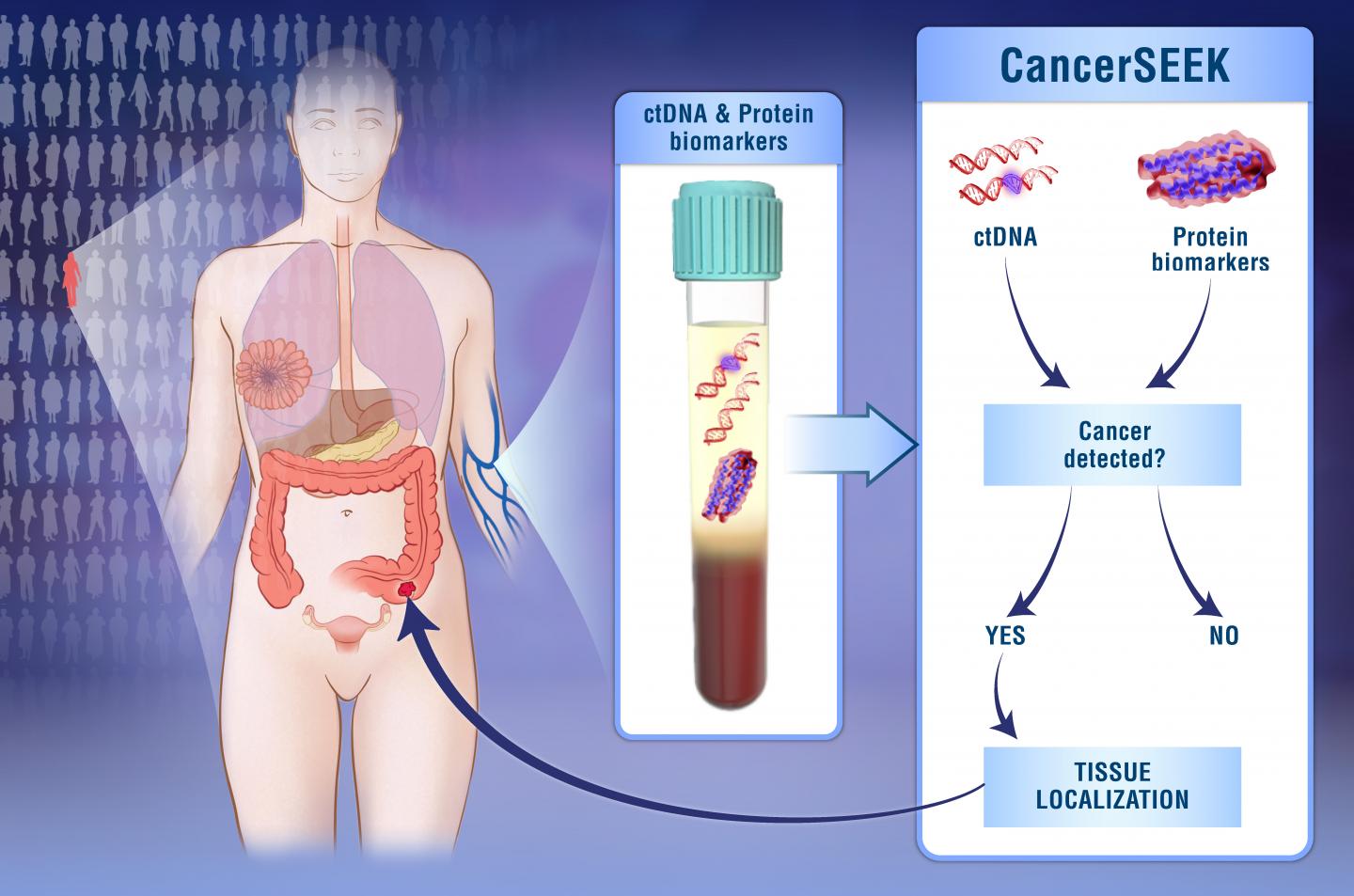
The team evaluated known biomarkers for their ability to help detect signs of solid tumors in the blood before they spread to other parts of the body. They searched for the most effective combination of known mutations to identify cancers using circulating tumor DNA (ctDNA)—pieces of DNA in the bloodstream that have been released from cancer cells. They also assessed protein biomarkers, since many early-stage tumors don’t release detectable amounts of ctDNA.
The test, called CancerSEEK, evaluates the presence of 2,001 genetic mutations and levels of eight proteins. The researchers tested CancerSEEK in 1,005 patients who had been diagnosed with cancer but whose cancers hadn’t yet spread at the time of enrollment. They tested 812 healthy controls for comparison.
CancerSEEK is an experimental blood test that detects and localizes eight common cancer types.
CancerSEEK is an experimental blood test that detects and localizes eight common cancer types. Elizabeth Cook and Kaitlin Lindsay
Overall, CancerSEEK detected 70% of the cancers. Sensitivity ranged from 98% for ovarian cancers to 33% for breast cancers. Sensitivity varied by cancer stage: 78% for Stage III cancers; 73% for Stage II cancers; and 43% for Stage I cancers. Only 7 of the 812 people without known cancers scored positive (>99% specificity).
The scientists used machine learning to predict the underlying cancer type in the 626 cancer patients who had positive CancerSEEK tests. They were able to narrow the source of the cancer to two organs in 83% of the patients and to a single organ in 63%.
“This test represents the next step in changing the focus of cancer research from late-stage disease to early disease, which I believe will be critical to reducing cancer deaths in the long term,” says co-lead researcher Dr. Bert Vogelstein.
“The use of a combination of selected biomarkers for early detection has the potential to change the way we screen for cancer, and it is based on the same rationale for using combinations of drugs to treat cancers,” says senior author Dr. Nickolas Papadopoulos.
The scientists estimate that the test will cost less than $500. The eight cancer types studied account for more than half of cancer deaths nationwide, and current screening tests with proven benefit are limited to only a few types of cancer. Earlier detection could potentially reduce deaths from these diseases. However, there were several limitations to this study. Further testing will be needed to measure the accuracy and predictive value of CancerSEEK in a clinical setting.
—by Harrison Wein, Ph.D.

Tuesday, 2 April 2019

UNTH Records 230 Successful Open-heart Surgeries

Chairman, National Cardiothoracic Centre of Excellence, University of Nigeria Teaching Hospital (UNTH), Ituku Ozalla, Enugu, Professor Basden Onwubere, has revealed that the centre successfully carried out about 230 open-heart surgeries since March 2013.

Onwubere, a former Provost of the College of Medicine, University of Nigeria Nsukka (UNN), disclosed that over half of the figure were children.

He disclosed this while responding to questions from reporters at the Akanu Ibiam International Airport, Enugu yesterday on activities of the centre.


He, however, stated that although UNTH started open-heart surgery in February 1974 and suspended in 2007 due to movement to its new site at Ituku Ozalla, the number carried out in the last six years outweighs surgeries carried out in 33 years from 1974 to 2007.

He attributed the progress to support of UNTH’s Chief Medical Director (CMD), Dr. Chris Amah, who not only supported the project financially, but also engaged some international partners and philanthropists who helped to smoothen the process of surgery.

Speaking, Amah, noted that he has no regrets investing on the open-heart project.

He stressed that his greatest joy was that the lives of some persons who could not have afforded the cost of surgery anywhere, were saved after successful open-heart operations at the hospital, adding that open-heart surgery at the UNTH has become a routine.

10 ways to prevent Stroke


Is stroke hereditary?

In the case of strokes, we do know that there is a hereditary component of several of the risk factors that lead to strokes. Unlike a disease like cancer, a stroke is not a primary disease. ... As a result, people with a family history of stroke should have their cholesterol levels and blood pressure monitored carefully.

Babcock University Teaching Hospital,Nigeria Performs First Successful Spinal Surgery

The Orthopaedic Department of Babcock University Teaching Hospital,Nigeria just achieved a great feat, as it performed its first successful spinal surgery.

Kelechukwu Onuoha, Consultant Orthopaedic and Trauma Surgeon with Babcock University Teaching Hospital, BUTH, who confirmed that they performed its first successful spinal surgery, said it was carried out under general anaesthesia on a middle-aged female patient with multi-level “spinal stenosis”.


Spinal stenosis is a narrowing of the spaces within the spine, which can put pressure on the nerves that travel through the spine. The condition occurs most often in the lower back and the neck. Some people with spinal stenosis may not have symptoms. According to Dr. Kelechukwu, the procedure uwas a revision spinal surgery L2 – L5 lumber spinal decompression and instrumentation.


The 59-years-old patient, who asked for protection of her identity, had undergone a spinal surgery five years earlier in another hospital,” he said.

Tuesday, 19 March 2019

Another Conjoined Twins Separated In ATBUTH Bauchi-Nigeria


A surgical feat by a team of medical experts has been achieved at the Abubakar Tafawa Balewa University Teaching Hospital (ATBUTH), Bauchi State-Nigeria

The medical team successfully separated another set of conjoined twins at its main theater under the headship of our foremost Pediatric Surgeon and Deputy CMAC Training, Dr Kefas Bwala.

This is the second such feat in less than twelve months.

Last year, a set of conjoined twins were separated at the same hospital, Bauchi.

Monday, 18 March 2019

Chinese Doctor Ling Zhipei Performs Remote Brain Surgery On Patient 3,000km Away

A Chinese doctor, Dr. Ling Zhipei has performed the first ever brain surgery over a 5G mobile network, according to Chinese media.

A patient with Parkinson's disease allegedly had an implant put in their brain by a doctor who was more than 1,800miles away (3,000km).

Using 5G technology, Dr Zhipei remotely implanted a neuro-stimulator into his patient’s brain on Saturday, moving instruments in PLAGH hospital in Beijing. The patient was in a clinic on the other side of the country, on the southern Hainan Island.

Allegedly, the surgery that ended successfully lasted for three hours. The patient, suffering from Parkinson’s disease, is said to be feeling well and is recovering.

The technology used for this pioneer surgery is based on a computer that uses a next generation 5G network developed by the Chinese tech giant Huawei. As the doctor moves the robotized arms with instruments, the 5G network enables the instant response of the same robotic arms on the other side of connection. According to Dr Zhipei, the feeling is as close at it can be as if the patient was really in front of him.

“You barely feel that the patient is 3,000 kilometers away,” he said.

The advantage of 5G digital networks over standard 4G is in their reliability. Conventional 4G has no capacity to transfer video without lagging, which often results in jumpy movement of a picture or video.

For years manufacturers of medical equipment have been racing to produce gear that lets surgeons operate from a distance, like the robotic “telesurgery” provided by the American da Vinci Surgical System. However, the system was too expensive and has some technical issues. The new 5G network offers the change that medical tech giants were looking for and China just proved that remote surgery is a new chapter in the history of medicine.

Remote surgery benefits are numerous. It could allow people from far-away regions or war zones to receive immediate help from top doctors around the globe.

Tuesday, 19 February 2019

Dinavir: New Cure For HIV Discovered In Russia

Hope for HIV cure brightens.

The Russian Central Research Institute of Epidemiology has developed a new gene therapy medicine for people living with HIV, head of the federal health watchdog Rospotrebnadzor, Anna Popova, said on Wednesday.

“The Central Research Institute of Epidemiology of Rospotrebnadzor created a fundamentally new drug for gene therapy, gene prophylactic treatment and molecular vaccination against HIV.

“A highly active antiviral drug called Dinavir, which will soon be clinically tested, has been created,” Popova said on the sidelines of an international conference on HIV and AIDS in Moscow.

The official noted that Russia was facing a number a number of problems related to treatment of HIV and AIDS, including high prices for treatment and lack of proper medications.

This is very much similar to the problems posed by HIV treatment in Nigeria.

Millions of people have been infected with HIV since it was first discovered

in early 1980s, prompting the development of drugs that would help tackle the deadly virus.

This is goodnews to Nigeria where it is estimated that every 5 out of 100 persons (5%) has HIV/AIDS. The number of people living with HIV vary from 1 to 12 in every 100 persons in the various states of the the country. In 2004, an estimated 3.2 to 3.8 million Nigerians have been infected by HIV making Nigeria the third highest prevalence rate worldwide; next to South Africa and India.

Though the rate of daily infection of HIV has dropped significantly due to efforts of the federal government, civil society organizations, multinational organisations, private individuals, among others; people living with the disease in Nigeria are desperately looking for “HIV cure”.

Wednesday, 16 May 2018

Experimental stroke drug succeeds in preliminary trials

A new anti-stroke drug has now successfully passed preliminary clinical trials, leading its developers to enthuse over its potential as a more effective treatment, less likely to be accompanied by unwanted health events.


In an effort to find an additional treatment that may protect against some of these effects, scientists from The Scripps Research Institute (TSRI) in La Jolla, CA, have developed a new drug called 3K3A-APC.
The drug is an engineered variant of activated protein C, which humans normally produce. It has been linked to the regulation of blood clotting and to certain aspects of the body's inflammatory response.
This new clinical trial was placebo-controlled, meaning that the drug's actual efficacy was tested against a placebo. It also set out to confirm how high a dose of the experimental drug would be safe for human participants.
Therefore, the scientists recruited 110 people who had had acute ischemic stroke and who were following treatment with tPA, intra-arterial thrombectomy, or both of these therapies.
The participants — all aged between 18 and 90 — were followed for a period of 90 days, as they were administered varying doses of the experimental drug.
The scientists experimented with four different dosages — 120, 240, 360, and 540 micrograms per kilogram. All four dose levels — including the highest one — were tolerated well by the subjects, so the researchers declared them safe for human use.
Also, the drug was seen to perform well in terms of results related to intracranial hemorrhage, or brain hemorrhage.
It was found that the drug helped to reduce both total hemorrhage volume, or how much blood "leaked," and hemorrhage incidence, or how often the participants experienced this event, significantly.
"The observed trend toward lower hemorrhage rates is consistent with our expectations based on the drug's mechanism of action and activity in animal studies," says Dr. Patrick Lyden, one of the researchers involved with the current clinical trial.
But he adds that "[t]hese results should be confirmed in a larger clinical trial." This, the researchers explain, will be their next step. They aim to eventually get FDA approval for the experimental drug.